
AI as a Culture Stress Test
Five Clashes That Surface in Finance Organizations
AI & DECISION CULTURE
Zhivka Nedyalkova
2/10/20264 min read

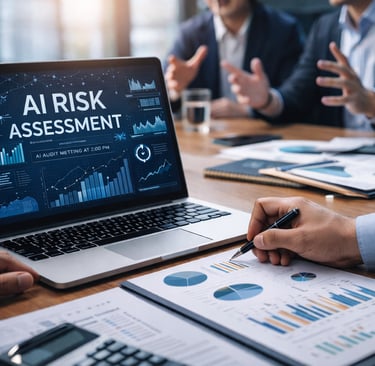
Five Clashes That Surface in Finance Organizations
Artificial intelligence is often framed as a technological breakthrough — faster analysis, greater efficiency, fewer manual processes. In practice, however, AI rarely behaves like just another tool. Much more often, it acts as a stress test for organizational culture, accelerating existing dynamics and exposing long-standing habits that were previously masked by familiar ways of working.
This becomes particularly visible in finance. Not because finance teams are inherently resistant to change, but because decision-making, risk, and accountability intersect there every day. AI does not change this reality. It makes it explicit.
The observations below are not a technical review. They are grounded in working with finance teams and leadership across organizations at different stages of maturity — and in observing how AI reshapes not only processes, but how organizations think about control, judgment, and responsibility.
1. Speed vs. Judgment
AI can deliver insights in seconds.
The tension this creates, however, is not about speed itself. It is about the loss of control over the process.
For decades, financial quality has been validated through process: structured steps, reconciliations, reviews, and versions. This model was not merely operational — it was psychological. Control over the process created a sense of risk containment, even when outcomes remained uncertain.
AI does not remove time. It removes the rituals through which control has traditionally been exercised. When analysis no longer passes through familiar checkpoints, perceived control disappears — even if the insight itself improves.
In practice:
A finance team implements AI-driven variance analysis. Instead of days of preparation, key deviations and drivers are available within minutes. The reaction is not relief, but discomfort. The analysis “has not passed through enough hands.” The concern is not accuracy, but how the team can be sure nothing has been missed.
Mature organizations recognize that control does not disappear — it shifts. From controlling every step to controlling decision criteria, assumptions, and accountability.
2. Automation vs. Accountability
As AI becomes embedded in financial workflows, a familiar question resurfaces: Who decides?
And shortly after: Who is accountable?
In many organizations, accountability has historically been diffuse. Decisions emerge gradually, distributed across meetings, spreadsheets, and reviews. As long as analysis remains slow, this ambiguity stays hidden. AI makes it visible.
When a model presents a clear scenario, inaction becomes a decision in itself.
In practice:
An AI model proposes a cost-optimization scenario with clearly quantified impact. Everyone agrees the insight is “interesting.” Yet decision timelines stretch. The delay is not driven by lack of information, but by the absence of a clearly defined decision owner.
AI does not assume accountability.
It requires that accountability be explicitly assigned.
3. Data vs. Context
A common critique of AI in finance is that it “doesn’t understand the business.”
More often than not, this reflects a different issue: the business itself has not been explicitly articulated in a way that can be understood — by AI or by people outside a small expert circle.
Financial data captures outcomes, not intent. Context often lives in conversations, emails, and institutional memory.
AI exposes this gap.
In practice:
A model flags declining margins and attributes them to rising costs. In reality, margins were intentionally sacrificed as part of a strategic pricing decision to enter a new market. The context exists — but nowhere in a structured, accessible form.
AI does not fail.
It reveals the limits of organizational memory.
4. Control vs. Trust
Many finance teams speak about transparency. In practice, they often seek control — granular, manual, and visible.
Spreadsheet culture exemplifies this dynamic. Visibility into every formula creates comfort. AI disrupts this model by shifting control from individual calculations to system-level logic.
In practice:
A CFO requests “full transparency” from an AI model, expecting traceability similar to a spreadsheet. When this is not possible in the same format, the tool is labeled risky.
The issue is not explainability.
It is a change in the form of control.
Control now resides in clearly defined frameworks: assumptions, constraints, escalation rules, and explicit stop conditions. Where these are not defined, AI is perceived as a threat — not because it is opaque, but because there is no agreed methodology for when to say yes, no, or it depends.
5. Optimization vs. Meaning
AI excels at optimization.
The question is: what exactly is being optimized?
Without clearly articulated priorities, optimization can accelerate the wrong direction — improving short-term metrics at the expense of long-term resilience.
In practice:
An AI model recommends tightening payment terms to improve working capital. The numbers look compelling. What the model does not capture is the strategic importance of certain client relationships and the potential long-term cost of erosion in trust.
AI optimizes what it is given.
If objectives are unclear or conflicting, optimization simply exposes that ambiguity.
Mature organizations use AI not to find the “best number,” but to explore trade-offs through scenario thinking.
Closing Reflection
AI does not change organizational culture.
It reveals it under pressure.
It exposes how organizations relate to uncertainty, how they exercise control, and how responsibility is distributed when decisions can no longer hide behind process. In finance, this exposure is particularly acute — not because finance is special, but because it sits at the intersection of risk, accountability, and consequence.
Seen through this lens, AI adoption is not a question of technological readiness.
It is a question of organizational maturity.
Where This Work Begins
That is precisely why we, the team at FinTellect AI, work with organizations through an AI Governance & Audit Assessment for financial processes — a structured evaluation of how AI is used across financial reporting, analysis, and planning, and whether decision boundaries, controls, and accountability frameworks are clearly defined and applicable in practice.
Our focus is on the governance of financial decision-making:
where AI supports analysis, where human judgment is required, and how financial risk is managed in real operational environments.
This assessment is particularly relevant for organizations implementing AI in finance, scaling existing AI-driven solutions, or seeking clearer structures for governing automation and accountability.
Final Note
AI will continue to accelerate.
What determines its impact is not the sophistication of the models, but the clarity of the frameworks within which they operate.
In finance, where decisions carry lasting consequences, governance is not a constraint on innovation.
It is what allows innovation to be trusted.
© 2026 FinTellect AI. All rights reserved.
Contacts
Fintellect AI
Knyaz Boris I 87, Sofia, Bulgaria
contact@fintellectai.com