
The Invisible Payment: How AI Turns Transactions Into a Frictionless Financial Pulse
How Machine Intelligence Turns Payments Into a Background Utility
CFO INSIGHTS
Zhivka Nedyalkova
12/9/20256 min read

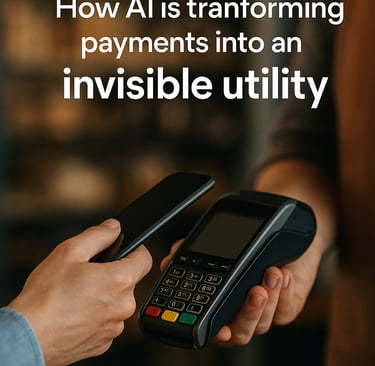
The Invisible Payment: How AI Turns Transactions Into a Frictionless Financial Pulse
AI × FinTech: The Global Shift — Article 5 of 6
There is a quiet revolution unfolding beneath every tap, swipe, and online checkout. Payments—once manual, visible, and occasionally painful—are disappearing into the background of daily life. What used to be a distinct financial act is becoming a near-instant decision made by networks of algorithms operating in milliseconds. The world of payments is no longer driven by execution, but by prediction.
Machine learning models now anticipate fraud before it happens, adapt authentication to each user’s behavior, orchestrate risk decisions on the fly, and personalize payment flows for millions of merchants and consumers. The payment itself has become the least interesting part of the transaction. The intelligence surrounding it—silent, always-on, anticipatory—is what defines the modern payments economy.
This article explores how AI is transforming payments into an invisible utility—a system that moves money with minimal friction, maximum trust, and unprecedented autonomy. And just as wealth management evolved from privilege to accessible technology, payments are evolving from a step in the buying process to the seamless fabric beneath global commerce.
I. The Slow Death of the Visible Payment
For decades, payments were an obstacle course. A card was swiped and sometimes declined. A merchant keyed in numbers and hoped they matched. Banks asked customers to remember passwords no one actually remembered. Fraud prevention was primitive: block everything that looks strange and hope for the best.
The experience was full of friction—friction that cost merchants money, frustrated consumers, and slowed down digital commerce. Behind the scenes, financial institutions were overwhelmed by manual reviews, rule-based systems that generated oceans of false positives, and fraud losses climbing into the tens of billions.
Yet the problem was deeper than inefficiency. Payments had to be visible because they weren’t intelligent. They required the user to perform the cognitive work—authenticate, confirm, verify, retry. The system relied on human intervention because it lacked the ability to decide autonomously.
AI is removing that requirement. In the emerging model, the smartest payment is the one you barely notice.
II. The AI Payment Stack: Intelligence Before Action
Across major payment networks—from Visa and Mastercard to Stripe, Adyen, Klarna, Revolut, and Square—a common transformation is underway. AI is shifting payments from sequential steps to a continuous flow of micro-decisions, many made before a customer even reaches checkout.
1. Adaptive Authentication
Authentication was once binary: password correct or not. Today, most of the decision happens invisibly through passive behavioral biometrics and device intelligence. AI analyzes typing cadence, finger pressure, accelerometer patterns, location consistency, historic behavior, merchant type, and even the subtle rhythms of how a user holds their phone.
Banks using behavioral authentication have seen fraud reduction between 20–50% without introducing new steps for customers (Experian, 2024). The payment is approved not because the user proves who they are, but because the system already knows.
2. Transaction-Level Risk Modeling
Stripe’s Radar and Adyen’s RevenueProtect evaluate hundreds of signals per transaction using machine learning trained on billions of global payment attempts. Visa reports that its AI-powered risk platform prevented over $27 billion in fraud in 2023, and Mastercard notes a 300% increase in detection accuracy for certain fraud types after shifting to deep learning models.
What matters is not just detection—it’s the fluid balancing of risk and experience. AI allows merchants to approve more legitimate users while reducing false declines that cost global businesses an estimated $443 billion annually (Kount, 2024).
3. Embedded Prediction
Payments are no longer simple requests. They are predictions: What is the likelihood this transaction is safe? Should the user be asked for more verification? Should the merchant be warned? Should a different payment method be recommended?
AI models compute these choices faster than a human can blink.
This intelligence stack does for payments what Google Maps did for navigation—it turns a once-manual task into a dynamic, automated process where the user experiences only the final, seamless output.
III. Why the Payment Disappears: Frictionless Commerce as the New Standard
The ultimate measure of progress is not accuracy or speed—it is invisibility. The more intelligent the system, the more it recedes from the customer’s awareness.
Buy-now-pay-later platforms use machine learning to approve purchases in under 200 milliseconds, evaluating creditworthiness without interrupting the checkout flow. Apple Pay and Google Pay convert authentication into a thumb press or brief glance. Subscription services automatically update expired card credentials using Visa Account Updater, reducing failed payments by 35–50% for participating merchants.
The invisible payment is not a luxury feature—it is now a competitive necessity. Companies that reduce checkout friction by even 100 milliseconds see measurable increases in conversion (Akamai, 2024). Every additional verification step risks abandonment; every unnecessary decline erodes trust. AI allows businesses to meet the expectations of a generation raised on instant gratification and effortless digital products.
IV. The Invisible Infrastructure: Where Banks, Networks, and AI Intersect
Behind the frictionless experience lies an increasingly autonomous infrastructure—one where banks, payment processors, and networks rely heavily on AI systems making millions of decisions per second.
Visa’s expansive network processes 65,000 transactions per second at peak capacity. Mastercard’s Decision Intelligence system evaluates each transaction against a multilayer neural network trained on years of fraud patterns. PayPal’s fraud AI retrains itself continuously on more than 1 billion daily transactions, spotting anomalies faster than human analysts ever could.
The trend is clear: AI is transitioning from a fraud-prevention add-on to a structural component of the payments industry. It is becoming the logic layer beneath global commerce.
And as with any infrastructural shift, the more efficient the system becomes, the less visible it is.
V. The Human Touchpoint Shrinks—but Trust Expands
The paradox of invisible payments is that reducing human interaction can make the system feel more trustworthy. Consumers trust systems that “just work.” Merchants trust processes that increase approvals while reducing fraud. Banks trust tools that lower financial crime losses.
But trust does not happen automatically—it is engineered through compliance, governance, and explainability.
The EU AI Act classifies fraud detection and AML systems as high-risk, requiring transparency and human oversight. This pushes payment providers to adopt explainable AI techniques that allow risk teams to understand why a given decision was triggered. Stripe, Adyen, Revolut, and Klarna now expose interpretable risk signals to merchants, turning the black box into a glass box.
The shift toward transparency is not a barrier to innovation—it is the foundation that allows invisible payments to scale globally.
VI. When Payments Become Background Infrastructure
As AI systems mature, payments will increasingly resemble electricity or the internet: a ubiquitous service that consumers notice only when it stops working.
Recurring subscriptions will adjust themselves based on spending patterns. Cross-border payments will settle instantly as AI reconciles regulatory requirements in real time. Peer-to-peer transfers will embed identity verification within the message layer. Smart wallets will choose the optimal funding source without user input.
And at the enterprise level, payments will become part of a broader trend toward autonomous finance, where treasury operations, cash management, and liquidity optimization occur algorithmically without manual intervention.
We are moving toward a world where the customer does not initiate payments—payments initiate themselves.
VII. The Future: Payments Without Payment
If the invisible payment is today’s innovation, the next era is the absent payment—a future where money moves before we even think about it.
AI will coordinate payments between devices, services, and platforms. Your car will pay its own tolls and charging fees. Your home will pay for energy based on real-time prices. Your digital assistant will negotiate subscription fees with providers’ AI systems. Merchants will be paid instantly with dynamic settlement triggered by risk-adjusted approvals.
The payment will no longer be an action. It will be a pulse within an autonomous financial ecosystem.
VIII. Conclusion: The Disappearing Transaction
Payments are becoming invisible not because they matter less, but because AI has made them smarter. As intelligence moves ahead of action, the friction once inherent to every transaction is dissolving into a fluid, predictive system that operates at the speed of thought.
This transformation reshapes not only how money moves, but how trust is built, how risk is managed, and how commerce evolves. And just as invisible payments redefine the consumer experience, they are laying the groundwork for the final stage of our series: the rise of autonomous CFO assistants, where entire finance functions—not just payments—begin to operate on their own.
The invisible payment is simply the first signal of a much larger shift.
Sources Cited
Visa Annual Report 2023: Fraud prevention statistics, network throughput
Mastercard Decision Intelligence, 2024 Product Overview
Experian Behavioral Biometrics Report, 2024
Stripe Radar ML documentation, 2024
Adyen RevenueProtect Insights, 2024
Kount Digital Fraud Trends Report, 2024
PayPal Q4 2024 Fraud Prevention Analyst Briefing
Akamai State of Digital Payments Performance, 2024
EU AI Act, 2024 Risk Classification Annex
Bloomberg, FT, TechCrunch reports on payment AI systems (2023–2025)
© 2026 FinTellect AI. All rights reserved.
Contacts
Fintellect AI
Knyaz Boris I 87, Sofia, Bulgaria
contact@fintellectai.com