
When Clients Pay Late, Liquidity Changes Faster Than You Think
How delayed payments quietly reshape cash and business decisions
CASE STUDY: LIQUIDITY
Zhivka Nedyalkova
3/12/20263 min read
Case Study 1— Liquidity
How delayed payments quietly reshape cash and business decisions
This case study is based on a real business scenario. Certain details have been adjusted to preserve confidentiality.
Many companies experience delayed payments from clients. Invoices stay open longer than expected, and cash arrives later than planned.
At first, this rarely looks like a serious problem.
Revenue is growing. The pipeline looks healthy. The business is profitable.
But liquidity pressure often builds quietly — and becomes visible only when several small shifts begin happening at the same time.
This is where many leadership teams realize that delayed payments are not only an accounting issue. They can quickly become a strategic one.
When payment timing begins to shift
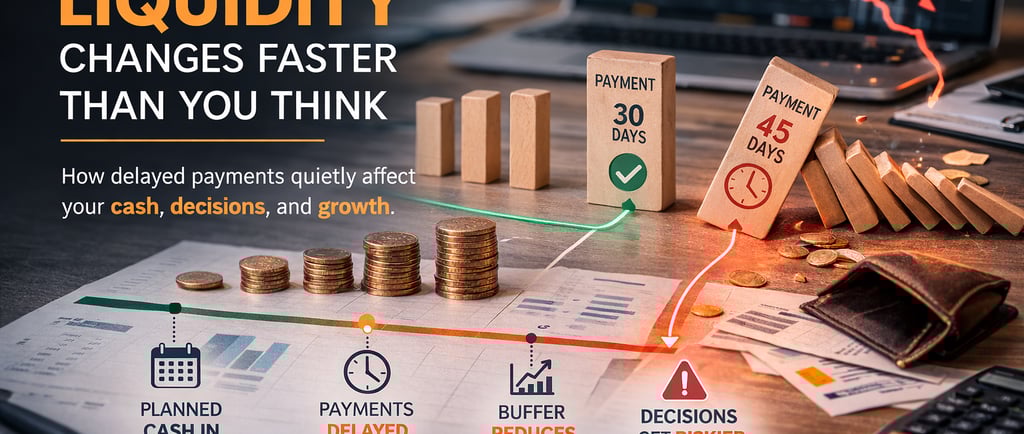
In this case, a growing company expected most client payments within 30 days. Operational planning was built around that assumption. The leadership team was preparing several decisions:
moderate hiring expansion
increased marketing activity
new supplier commitments
On paper, everything looked reasonable. Revenue projections were stable and the business itself was healthy. However, payment timing gradually began to move closer to 40–45 days.
At first, the difference seemed manageable. The revenue was still there. It simply arrived later.
But cash timing changes something important: operational flexibility.
Why delayed payments affect more than accounting
When payments slow down, companies often respond operationally. They may:
send payment reminders
negotiate new payment terms
delay certain expenses
tighten short-term spending
These actions can help. But they usually address the situation after pressure is already visible. The more important question for leadership teams is different:
How much liquidity pressure can the business absorb before decisions need to change?
Without clarity on that impact, decisions are often made based on intuition rather than structured analysis.
What the scenario revealed
In this case, the company analyzed what would happen if payment timing extended from 30 to 45 days. The results were revealing. Cash inflows began arriving later than operational spending. Over several months, the company’s operational buffer narrowed significantly. The business remained profitable. Revenue growth did not disappear.
But liquidity flexibility changed. Decisions that looked safe under the original assumptions started to carry more risk.
Hiring plans, supplier commitments, and marketing investments all depended on one critical factor: when cash actually arrived.
Why liquidity pressure is often hard to see early
Liquidity risk rarely comes from one dramatic event. More often, it emerges from several small changes happening simultaneously:
slightly slower client payments
increased operational spending
hiring commitments
delayed revenue ramp-up
Separately, none of these shifts may look alarming. Together, they can significantly change how much room a business has to maneuver.
The challenge is that these interactions are not always visible in traditional reports or spreadsheets. By the time liquidity pressure becomes obvious, leadership teams often have fewer options to adjust.
Testing decisions before committing
Instead of reacting after pressure appears, some companies now have the chance to test decision scenarios before committing. Using structured financial modeling, leadership teams can explore questions such as:
What happens if payment timing extends by 10–15 days?
How does this affect liquidity over the next quarter?
Can hiring plans still proceed safely?
Should the timing of expansion change?
These simulations help leaders understand how sensitive their business is to timing changes. Sometimes the decision itself does not change. But the moment when it is executed does.
The real insight
Delayed payments rarely mean that a company is in trouble.
But they do change the conditions under which other decisions are made. Hiring, expansion, pricing adjustments, and operational investments all depend on one simple factor:
cash arriving when expected.
Understanding how timing shifts affect liquidity can turn a reactive situation into a strategic one. And that difference often determines how confidently leadership teams can move forward.
Explore a similar scenario
If your company is evaluating decisions that could affect liquidity- such as hiring, expansion, or pricing changes- it can be useful to simulate the impact before committing.
You can explore how this works in a short strategic session.
© 2026 FinTellect AI. All rights reserved.
Contacts
Fintellect AI
Knyaz Boris I 87, Sofia, Bulgaria
contact@fintellectai.com