
How Financial Processes Are Changing and Why Most Companies Are Not Ready
From structured workflows to dynamic decision systems
CFO INSIGHTS
Zhivka Nedyalkova
6/30/20263 min read
How Financial Processes Are Changing And Why Most Companies Are Not Ready
From structured workflows to dynamic decision systems
For decades, financial processes have followed a predictable structure. Data is collected. Transactions are recorded. Reports are generated. Decisions are made at the end of the cycle. Monthly closes, quarterly reviews, annual planning- the rhythm of finance has been built around fixed timelines and structured workflows. The process was designed for stability, consistency, and control.
And for a long time, that model worked.
But today, the environment in which these processes operate has fundamentally changed.
Markets move faster. Costs fluctuate more frequently. Customer behavior shifts unexpectedly. And decisions can no longer wait for the end of the reporting cycle. Yet most financial processes still do.
The growing gap between process and reality
One of the key themes in the Future of Finance report is that financial processes are becoming increasingly dynamic, while the structures behind them remain largely static. This creates a gap.
A gap between how businesses operate and how finance supports them.
On one side, you have a business that needs to react in real time. On the other, a finance function that is still optimized for periodic reporting. The result is familiar.
By the time insights are available, the situation has already changed.
Why traditional processes are starting to break
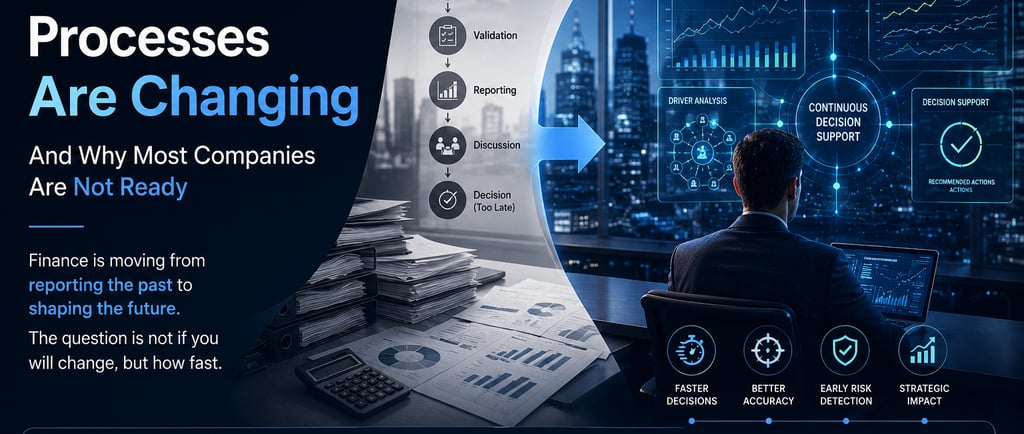
Traditional financial processes are built on a sequence of steps.
First comes data. Then validation. Then reporting. Then discussion.
And only then- decision.
This sequence assumes that information flows in one direction, and that decisions can be made after the fact.
But in today’s environment, this linear model is no longer sufficient. Because business conditions do not wait for the process to complete.
Multiple variables move at the same time. Changes happen continuously. And decisions often need to be made before the full picture is available.
This is where the process begins to break. Not because it is incorrect. But because it is too slow.
The shift toward continuous decision-making
Leading companies are starting to rethink this model.
Instead of treating finance as a function that operates in cycles, they are moving toward continuous decision support.
This means:
replacing static forecasts with dynamic ones
moving from periodic reporting to real-time visibility
shifting from retrospective analysis to forward-looking scenarios
But the most important change is not technological.
It is conceptual.
Finance is no longer just about explaining what happened. It is about supporting decisions as they happen.
Why most companies are not ready
Despite this shift, many organizations are still operating with processes designed for a different reality.
They have:
✔ better tools
✔ more data
✔ faster reporting
But the underlying logic of the process remains the same. And this creates a hidden limitation. Because even with real-time dashboards, decisions are often still based on:
static assumptions
single forecasts
limited scenario testing
In other words, the process has improved. But it has not evolved.
From workflows to decision systems
The next stage in the evolution of finance is not just faster processes. It is a different type of process altogether. One that is built not around steps, but around decisions.
Instead of asking: “Have we completed the reporting cycle?” The question becomes: “Do we understand how this decision will play out?”
This requires a shift from workflows to systems. Systems that connect:
data
drivers
scenarios
outcomes
And allow finance teams to explore how different decisions behave under changing conditions.
The role of AI and hybrid models
This is where AI and hybrid intelligence models begin to play a critical role. Not as a replacement for finance professionals, but as an extension of their capabilities.
By processing complexity faster and simulating multiple scenarios, these systems allow teams to:
test decisions before committing
understand interactions between variables
detect risks earlier
respond more quickly to change
This is not about automation. It is about augmentation.
The real question
The question is no longer whether financial processes will change. They already are.
The real question is: how quickly organizations can adapt to this new reality Because the gap between static processes and dynamic business environments is only getting wider. And companies that fail to close it will find themselves constantly reacting — instead of leading.
Explore what this means in practice
This is exactly what we will explore in our upcoming session.
How financial processes are evolving in real organizations
Where traditional models break down
And how finance teams can move toward real-time, decision-driven processes
© 2026 FinTellect AI. All rights reserved.
Contacts
Fintellect AI
Knyaz Boris I 87, Sofia, Bulgaria
contact@fintellectai.com