
The Hidden Trade- Off Behind Business Growth
Why increasing revenue can weaken liquidity- and how to see it before it happens
CFO INSIGHTS
Zhivka Nedyalkova
4/2/20262 min read

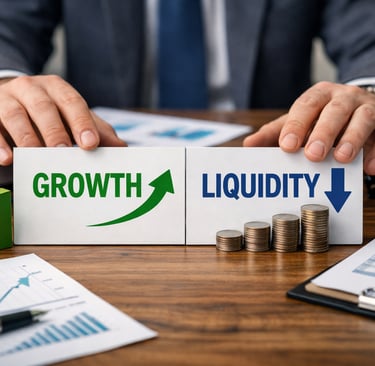
Case Study 2 — Growth vs Liquidity
Why increasing revenue can quietly liquidity- and how to see it before it happens
This case study is based on a real business scenario. Certain details have been adjusted to preserve confidentiality.
Growth is often seen as an unequivocally positive signal. Higher revenue. More customers. Expanding market presence.
And in many cases, it is. But growth has another side- it changes the dynamics of cash, costs, and risk.
The challenge is that this shift is rarely visible at the beginning.
When growth starts to accelerate
In this case, a growing company was experiencing steady revenue expansion.
The leadership team began preparing for the next phase:
expanding the team
increasing marketing investments
committing to new operational initiatives
The projections looked solid. Demand was there. The logic was straightforward: invest to accelerate growth.
At this stage, the question was not whether to grow- but how fast.
What is not immediately visible
As revenue increased, other elements began to shift:
higher customer servicing costs
growing accounts receivable
earlier cash outflows compared to inflows
Growth requires funding, often before revenue is actually converted into cash.
In this case, the company maintained healthy margins. But the timing gap between spending and cash collection started to widen. What looked like acceleration is starting to introduce pressure.
What the scenario revealed
The company analyzed what would happen if growth accelerated by an additional 15%, accompanied by increased operating costs and marketing spend. The result was not one-dimensional.
Revenue increased, as expected. Market position improved.
But:
the liquidity buffer started to shrink
dependence on timely payments increased
sensitivity to deviations from projections grew
In one scenario, even a slight delay in cash inflows led to the need for external financing.
The growth decision itself was not wrong. But it became more fragile.
Where the real trade-off emerges
Growth and stability are not opposites. But there is tension between them.
In this case, the key question shifted from:
“Should we grow?”
to
“Under what conditions does this growth remain sustainable?”
This includes:
how much liquidity buffer is required
what level of risk the business can absorb
how resilient the plan is under less favorable scenarios
Without this clarity, growth decisions are often driven by potential- rather than sustainability.
Why this is hard to see early
This type of tension rarely appears in standard financial reports.
Because:
revenue is analyzed separately from cash
costs are planned without fully reflecting timing differences
scenarios are evaluated in isolation
In reality, these elements move together. And small changes- in payment timing, costs, or growth pace-
can lead to very different outcomes.
Testing growth before committing
In this case, the key difference came from the ability to test the decision before executing it.
The leadership team explored questions such as:
What happens if growth accelerates, but payments slow down?
How much liquidity is required to sustain this pace?
At what point does growth start increasing risk rather than value?
These simulations did not eliminate the decision to grow. But they made it more informed. And often — better timed.
The real insight
Growth is not just about opportunity. It is about balance.
Between revenue and cash. Between speed and stability. Between potential and risk.
Understanding this balance allows companies not just to grow- but to do so with confidence.
If this feels familiar
If you are currently evaluating decisions related to expansion, hiring, or increased investment- it may be useful to understand how these choices impact liquidity and risk before committing.
In a short strategic session, we can simulate different scenarios and show how changes in growth affect your financial position.
→ Schedule a 30-minute strategic session
https://calendly.com/zhivka-nedyalkova-fintellectai/strategic_session
© 2026. All rights reserved.
© 2026 FinTellect AI. All rights reserved.
Contacts
Fintellect AI
Knyaz Boris I 87, Sofia, Bulgaria
contact@fintellectai.com