
The Most Misleading Metric in Finance
And why one number is not enough to guide a decision
CFO INSIGHTS
Zhivka Nedyalkova
6/16/20263 min read

The Most Misleading Metric in Finance
And why one number is rarely enough to guide a decision
In almost every business, there is a tendency to focus on one number.
A number that becomes the reference point for decisions. A number that is discussed in meetings, tracked over time, and used as a signal of whether things are going well or not. It may be revenue, profit, EBITDA, or growth rate. The specific metric varies, but the role it plays is often the same.
It simplifies complexity.
And that is precisely where the problem begins.
Financial metrics are designed to summarize performance. They compress multiple variables into a single, easy-to-understand figure. This is what makes them useful. But it is also what makes them misleading when used in isolation.
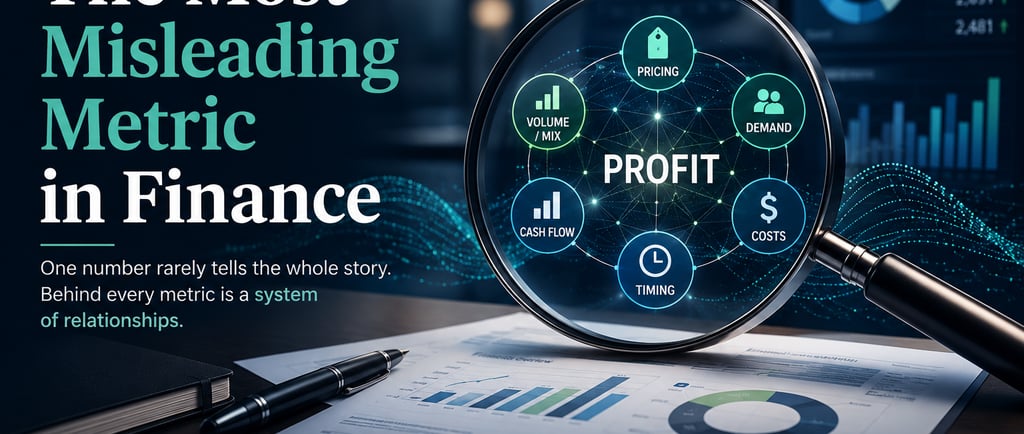
Because behind every number, there is a system of relationships.
Revenue reflects not only demand, but also pricing decisions, market conditions, and customer behavior. Profit depends not just on costs, but on how those costs evolve relative to growth. Even cash flow, often seen as one of the most reliable indicators, is shaped by timing, payment structures, and operational commitments.
A single number does not capture these dynamics. It hides them.
And yet, many decisions continue to be anchored around exactly that — a simplified representation of a much more complex reality.
This becomes particularly visible in situations where the metric appears strong, but the underlying conditions are shifting. A company may report steady growth while margins quietly deteriorate. Profitability may look stable even as liquidity pressure begins to build. Revenue may increase, masking changes in customer behavior that could affect future performance.
In such cases, the metric is not incorrect.
It is incomplete.
The issue is not that financial indicators are unreliable. On the contrary, they are essential. The issue is that they are often interpreted as standalone signals, rather than as outcomes of interacting factors.
When decisions are based on a single metric, the implicit assumption is that the drivers behind it will remain stable. But in practice, they rarely do.
A pricing decision, for example, may improve margins in the short term, but affect demand over time. A cost reduction may increase profitability, while creating operational constraints that limit growth. An investment in expansion may boost revenue, but introduce pressure on cash flow that is not immediately visible.
Each of these decisions can be justified by a metric.
And each of them can lead to very different outcomes depending on how multiple variables evolve together.
This is where the limitation of single-metric thinking becomes clear.
It creates the illusion of clarity.
It suggests that if the number is moving in the right direction, the decision is correct. But in reality, the number is only the surface of a deeper system. Without understanding the forces behind it, the direction itself can be misleading.
The challenge, then, is not to replace metrics, but to reinterpret them.
Instead of asking whether a number is improving, the more useful question is what is driving that improvement, and how stable those drivers are under different conditions. Instead of focusing on the outcome alone, the focus shifts to the relationships that produce it.
This requires a different way of working with financial data.
Not one that reduces complexity to a single figure, but one that explores how multiple factors interact and how outcomes change when those factors move. It requires looking beyond the metric itself and into the structure behind it.
Because in the end, no single number can fully capture the reality of a business.
Decisions are not made in a single dimension. They are shaped by trade-offs, dependencies, and timing. And understanding those elements is what allows businesses to move from reacting to results to actively shaping them.
If this feels familiar, it is likely because the limitation is not in the data, but in the way it is framed.
With our What-If approach, you can go beyond single metrics and explore how different drivers interact under changing conditions — using your own financial data.
This allows you to understand not just whether a number is improving, but why, and what could happen next if the underlying factors change.
👉 Book a 30-minute strategy session to see how this works in practice
© 2026 FinTellect AI. All rights reserved.
Contacts
Fintellect AI
Knyaz Boris I 87, Sofia, Bulgaria
contact@fintellectai.com