Why “What If” Is the Most Important Question in Finance
And why most businesses don’t ask it properly
CFO INSIGHTS
Zhivka Nedyalkova
6/2/20263 min read
Why “What If” Is the Most Important Question in Finance
And why most businesses don’t ask it properly
For most businesses, financial analysis follows a familiar pattern. Data is collected, structured, and reviewed. Reports are generated, performance is measured, and trends are discussed in regular cycles. The process is designed to bring clarity, and in many ways, it succeeds. It provides a structured view of what has happened and, to some extent, what is expected to happen next.
But when the moment for decision arrives, the nature of the problem changes. The focus shifts from understanding the past to navigating the future. And this is where a different type of question becomes far more important — one that is often overlooked or only partially explored: what if?
Every meaningful financial decision carries a degree of uncertainty. Not because the data is missing, but because the future does not follow a single, predictable path. A pricing adjustment may influence demand in ways that are difficult to anticipate. Costs may increase at the same time as growth begins to slow. Cash inflows may arrive later than expected, even as commitments remain fixed. These are not exceptional situations; they are part of the normal dynamics of business.
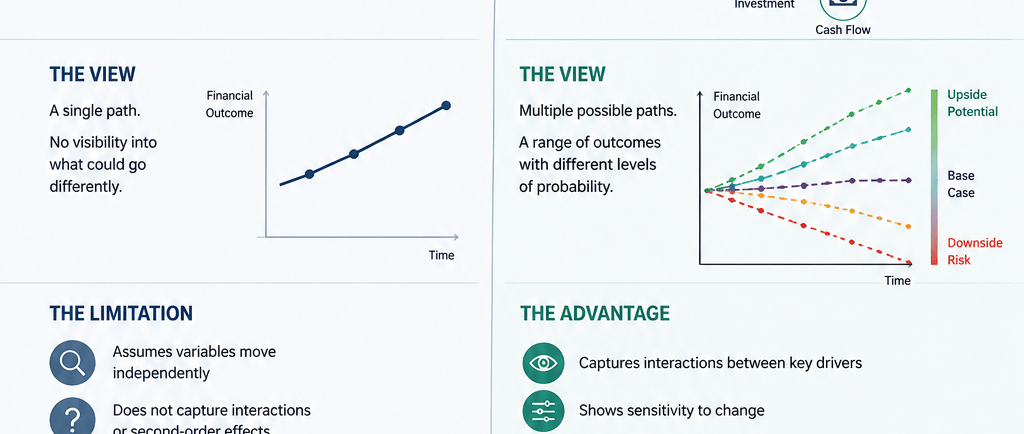
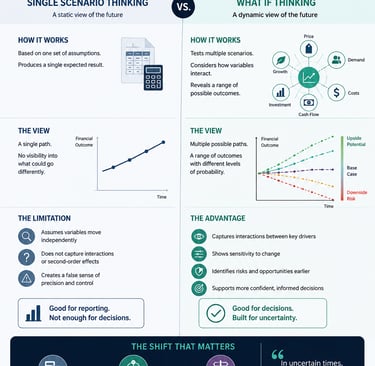
Despite this, many decisions are still made based on a single scenario. A model is built, assumptions are defined, and a result is calculated. That result is then treated as the most likely outcome, forming the basis for action. The logic behind the decision may be sound, but the perspective is limited. Real business conditions rarely unfold in a straight line. Multiple variables move at the same time, and even small changes can alter the overall outcome in meaningful ways.
In some organizations, the question “What if?” is asked, but often in a simplified form. A second scenario is tested, perhaps reflecting a more optimistic or more conservative outlook. While this adds value, it still treats variables as if they operate independently. In practice, they do not. A change in pricing influences demand, which in turn affects revenue, which then impacts cash flow and the ability to invest or expand. These relationships form a system, not a sequence of isolated inputs.
This is where many decisions, even those that appear well-tested, begin to diverge from expectations. The issue is not that the analysis is incorrect, but that it does not fully capture how different factors interact under changing conditions. Testing one variable at a time can create a false sense of control, while the real risk lies in how variables move together.
The true value of “What if” thinking lies not in identifying a single alternative outcome, but in understanding the range of possible ones. It shifts the focus from predicting what will happen to exploring what could happen under different conditions. This distinction may seem subtle, but it changes the nature of decision-making. Instead of relying on a single projection, businesses gain visibility into how sensitive their results are to change, where the key risks lie, and which factors have the greatest influence on the outcome.
This shift has become increasingly important as business environments grow more complex. Markets move faster, costs fluctuate more frequently, and customer behavior is less predictable. Under these conditions, relying on a single scenario is no longer sufficient. It limits visibility and increases the likelihood of unexpected outcomes.
The challenge, therefore, is not to eliminate uncertainty, but to understand it before committing to a decision. This requires a different approach — one that moves beyond static assumptions and explores how outcomes evolve when multiple variables change simultaneously. It requires seeing financial data not just as a record of performance, but as a system of interconnected drivers.
Most financial tools are designed to answer one question well: what is happening? Some extend this to what is likely to happen. But decisions require something more nuanced- an understanding of what happens if conditions change, and how those changes ripple through the business.
In the end, the difference between a sound decision and a risky one is rarely found in the logic itself. It lies in whether the range of possible outcomes has been fully considered. In that sense, “What if?” is not just a useful question. It is the question that defines how decisions are made.
If this sounds familiar, it is likely because the gap is not in the data, but in the visibility behind it. Exploring that gap- and understanding how decisions behave under different conditions- is what allows businesses to move from confident assumptions to informed choices.
© 2026 FinTellect AI. All rights reserved.
Contacts
Fintellect AI
Knyaz Boris I 87, Sofia, Bulgaria
contact@fintellectai.com